
Run an epicrop Disease Model Across Emergence Dates and Locations
Source:R/run_epicrop_model.R
run_epicrop_model.RdA unified interface to execute any epicrop disease model
(bacterial_blight(), brown_spot(), leaf_blast(), etc.) over multiple
emergence dates and/or locations. Handles cross-year and within-year weather
windows automatically without global weather binding.
Usage
run_epicrop_model(
  model_fun,
  emergence_dates,
  wth_list,
  window_days = 120L,
  output = "audpc",
  ...
)
Arguments
- model_fun
Function. An epicrop model function such as:
bacterial_blight(),brown_spot(),leaf_blast(),sheath_blight(),tungro(),modified_kim_leaf_blast(),modified_kim_sheath_blight(),leaf_rust(), ors_tritici_blotch().- emergence_dates
Vector of emergence dates (character
"YYYY-MM-DD", Date, or data.table::IDate; must be of classepicrop.emergefrombuild_epicrop_emergence()).- wth_list
Named list of weather data.table::data.tables, one per year.
Names must be year strings (e.g.,
"2001","2002")Each table must have a
YYYYMMDDcolumn (Date, IDate, or ISO string)Typically created by
get_epicrop_weather_list()Can also be an
epicrop.wth.bundle(multiple locations)
- window_days
Integer. Days after emergence to simulate (default 120L). The model will run for exactly
window_daysrows when sufficient weather is available. Ifemergence_datesis at year-end, spans into next year.- output
Character. Output format:
"audpc"(default): Compact summary with emergence date and AUDPC"full": All daily model columns plusemergenceandAUDPC
- ...
Additional arguments forwarded to
model_fun(e.g.,RcOpt,simple_wetness, custom modifier tables). Overrides model defaults.
Value
If
output = "audpc":Columns:
emergence(IDate),AUDPC(numeric)One row per emergence date
AUDPC = NA_real_if weather data are insufficient
If
output = "full":All columns from the disease model (sites, latent, infectious, etc.)
Plus
emergence(IDate) andAUDPC(numeric)Multiple rows per emergence date (one per simulated day)
Class set to
epicrop.simfor S3 methods
If
wth_listis a bundle (multiple locations):Additional
locationcolumn identifying source bundle member
Workflow
This function bridges get_epicrop_weather_list() (weather prep) and
build_epicrop_emergence() (emergence date generation) with disease models.
For each emergence date, it:
Slices weather data spanning emergence to emergence +
window_days - 1Handles year boundaries (e.g., Dec 15 – Jan 15)
Executes the model with the sliced weather
Returns either a compact AUDPC summary or full daily progression
Supports weather bundles (multiple locations) by processing each location
independently and combining results with a location column.
Cross-Year Windows
When an emergence date + window_days spans two calendar years (e.g.,
Dec 15 – Feb 15), the function automatically:
Fetches weather from both years
Stitches them in chronological order
Returns a contiguous window
Missing data (no weather for a required year) produces a warning and
AUDPC = NA_real_.
Bundle Processing
If wth_list is an epicrop.wth.bundle (from get_epicrop_weather_list()
with multiple locations or location-date pairs):
Each bundled weather object is processed independently
Results are combined with a
locationcolumnLocation labels extracted from bundle names (text before
"__")
See also
build_epicrop_emergence()– Construct emergence date vectorsget_epicrop_weather_list()– Prepare weather dataget_audpc()– Extract/compute AUDPC from resultsseir()– Core SEIR modelleaf_blast(),sheath_blight(), etc. – Individual disease models
Author
Adam H. Sparks, adamhsparks@gmail.com
Examples
# --- Example 1: Single location, multiple emergence dates ---
# Build emergence dates (every 15 days, June–July, years 2001–2003)
years <- 2001:2003
month_days <- c("-06-01", "-06-15", "-07-01")
emergence <- build_epicrop_emergence(years, month_days)
# Fetch weather (one year per element)
lonlat <- c(121.255669, 14.16742)
wth_list <- get_epicrop_weather_list(
lonlat = lonlat,
start_date = month_days,
duration = 120L,
years = years
)
# Run leaf blast model across all emergence dates
results <- run_epicrop_model(
model_fun = leaf_blast,
emergence_dates = emergence,
wth_list = wth_list,
window_days = 120L,
output = "audpc"
)
head(results)
#> Key: <emergence, AUDPC>
#> emergence AUDPC
#> <epicrop.emerge> <num>
#> 1: 2001-06-01 38.19575
#> 2: 2001-06-15 36.86150
#> 3: 2001-07-01 43.86372
#> 4: 2002-06-01 40.34144
#> 5: 2002-06-15 38.03268
#> 6: 2002-07-01 37.42458
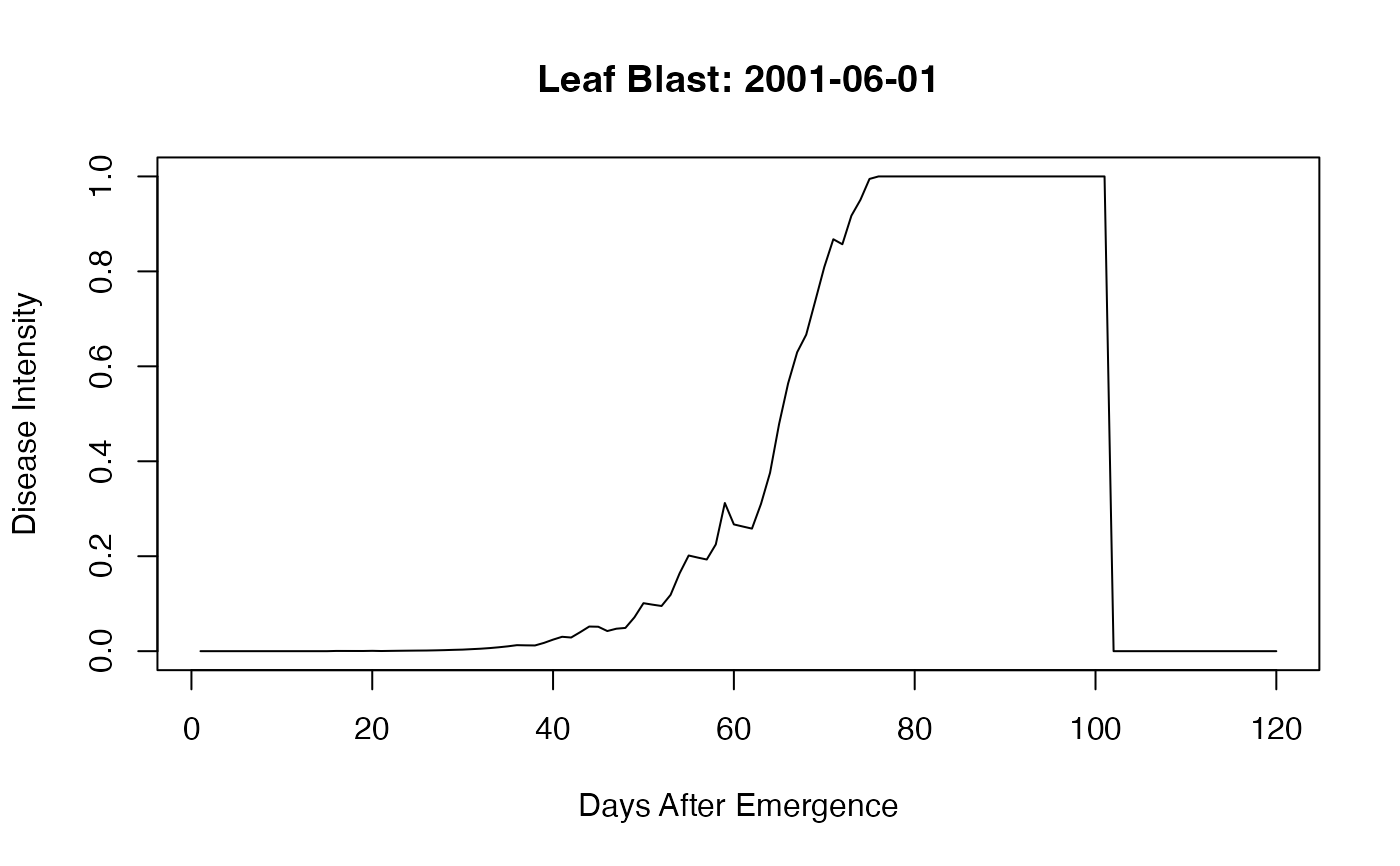
# --- Example 2: Full progression output for detailed analysis ---
full_results <- run_epicrop_model(
model_fun = leaf_blast,
emergence_dates = emergence[1:5], # First 5 dates
wth_list = wth_list,
window_days = 120L,
output = "full"
)
# Plot disease progression for first emergence date
first_date <- emergence[1]
sub <- full_results[emergence == first_date]
plot(sub$simday, sub$intensity, type = "l",
main = paste("Leaf Blast:", first_date),
xlab = "Days After Emergence", ylab = "Disease Intensity")
 # --- Example 3: Sensitivity analysis (modify RcOpt) ---
# Susceptible cultivar
susceptible <- run_epicrop_model(
model_fun = leaf_blast,
emergence_dates = emergence,
wth_list = wth_list,
window_days = 120L,
output = "audpc",
RcOpt = 1.14 # Default
)
#> Error in seir(wth = wth, emergence = emergence, RcA = RcA %||% params$RcA, RcT = RcT %||% params$RcT, RRG = RRG %||% params$RRG, RRS = RRS %||% params$RRS, onset = 15L, duration = 120L, rhlim = rhlim %||% 90L, rainlim = rainlim %||% 5L, H0 = 600L, I0 = 1L, RcOpt = 1.14, p = 5L, i = 20L, a = 1L, Sx = 30000L, simple_wetness = TRUE, age_driver = "day", ...): formal argument "RcOpt" matched by multiple actual arguments
# Resistant cultivar (lower infection rate)
resistant <- run_epicrop_model(
model_fun = leaf_blast,
emergence_dates = emergence,
wth_list = wth_list,
window_days = 120L,
output = "audpc",
RcOpt = 0.8 # Lower
)
#> Error in seir(wth = wth, emergence = emergence, RcA = RcA %||% params$RcA, RcT = RcT %||% params$RcT, RRG = RRG %||% params$RRG, RRS = RRS %||% params$RRS, onset = 15L, duration = 120L, rhlim = rhlim %||% 90L, rainlim = rainlim %||% 5L, H0 = 600L, I0 = 1L, RcOpt = 1.14, p = 5L, i = 20L, a = 1L, Sx = 30000L, simple_wetness = TRUE, age_driver = "day", ...): formal argument "RcOpt" matched by multiple actual arguments
comparison <- data.table(
emergence = susceptible$emergence,
susceptible_AUDPC = susceptible$AUDPC,
resistant_AUDPC = resistant$AUDPC
)
#> Error in data.table(emergence = susceptible$emergence, susceptible_AUDPC = susceptible$AUDPC, resistant_AUDPC = resistant$AUDPC): could not find function "data.table"
comparison[, reduction := 1 - (resistant_AUDPC / susceptible_AUDPC)]
#> Error: object 'comparison' not found
comparison
#> Error: object 'comparison' not found
# --- Example 4: Bundle processing (multiple locations) ---
locations <- rbind(
"IRRI" = c(121.255669, 14.16742),
"Laguna" = c(121.2, 14.1)
)
wth_bundle <- get_epicrop_weather_list(
lonlat = locations,
start_date = month_days,
duration = 120L,
years = years,
mode = "cross" # All location × date combinations
)
bundle_results <- run_epicrop_model(
model_fun = leaf_blast,
emergence_dates = emergence,
wth_list = wth_bundle,
window_days = 120L,
output = "audpc"
)
# Results now have a 'location' column
bundle_results[, .N, by = location]
#> location N
#> <char> <int>
#> 1: IRRI 9
#> 2: Laguna 9
# --- Example 3: Sensitivity analysis (modify RcOpt) ---
# Susceptible cultivar
susceptible <- run_epicrop_model(
model_fun = leaf_blast,
emergence_dates = emergence,
wth_list = wth_list,
window_days = 120L,
output = "audpc",
RcOpt = 1.14 # Default
)
#> Error in seir(wth = wth, emergence = emergence, RcA = RcA %||% params$RcA, RcT = RcT %||% params$RcT, RRG = RRG %||% params$RRG, RRS = RRS %||% params$RRS, onset = 15L, duration = 120L, rhlim = rhlim %||% 90L, rainlim = rainlim %||% 5L, H0 = 600L, I0 = 1L, RcOpt = 1.14, p = 5L, i = 20L, a = 1L, Sx = 30000L, simple_wetness = TRUE, age_driver = "day", ...): formal argument "RcOpt" matched by multiple actual arguments
# Resistant cultivar (lower infection rate)
resistant <- run_epicrop_model(
model_fun = leaf_blast,
emergence_dates = emergence,
wth_list = wth_list,
window_days = 120L,
output = "audpc",
RcOpt = 0.8 # Lower
)
#> Error in seir(wth = wth, emergence = emergence, RcA = RcA %||% params$RcA, RcT = RcT %||% params$RcT, RRG = RRG %||% params$RRG, RRS = RRS %||% params$RRS, onset = 15L, duration = 120L, rhlim = rhlim %||% 90L, rainlim = rainlim %||% 5L, H0 = 600L, I0 = 1L, RcOpt = 1.14, p = 5L, i = 20L, a = 1L, Sx = 30000L, simple_wetness = TRUE, age_driver = "day", ...): formal argument "RcOpt" matched by multiple actual arguments
comparison <- data.table(
emergence = susceptible$emergence,
susceptible_AUDPC = susceptible$AUDPC,
resistant_AUDPC = resistant$AUDPC
)
#> Error in data.table(emergence = susceptible$emergence, susceptible_AUDPC = susceptible$AUDPC, resistant_AUDPC = resistant$AUDPC): could not find function "data.table"
comparison[, reduction := 1 - (resistant_AUDPC / susceptible_AUDPC)]
#> Error: object 'comparison' not found
comparison
#> Error: object 'comparison' not found
# --- Example 4: Bundle processing (multiple locations) ---
locations <- rbind(
"IRRI" = c(121.255669, 14.16742),
"Laguna" = c(121.2, 14.1)
)
wth_bundle <- get_epicrop_weather_list(
lonlat = locations,
start_date = month_days,
duration = 120L,
years = years,
mode = "cross" # All location × date combinations
)
bundle_results <- run_epicrop_model(
model_fun = leaf_blast,
emergence_dates = emergence,
wth_list = wth_bundle,
window_days = 120L,
output = "audpc"
)
# Results now have a 'location' column
bundle_results[, .N, by = location]
#> location N
#> <char> <int>
#> 1: IRRI 9
#> 2: Laguna 9