Convenience wrappers around seir() with pre-configured parameter tables
for well-characterized crop diseases. Each function encapsulates parameters
from published epidemiological studies, allowing one-line disease
simulations.
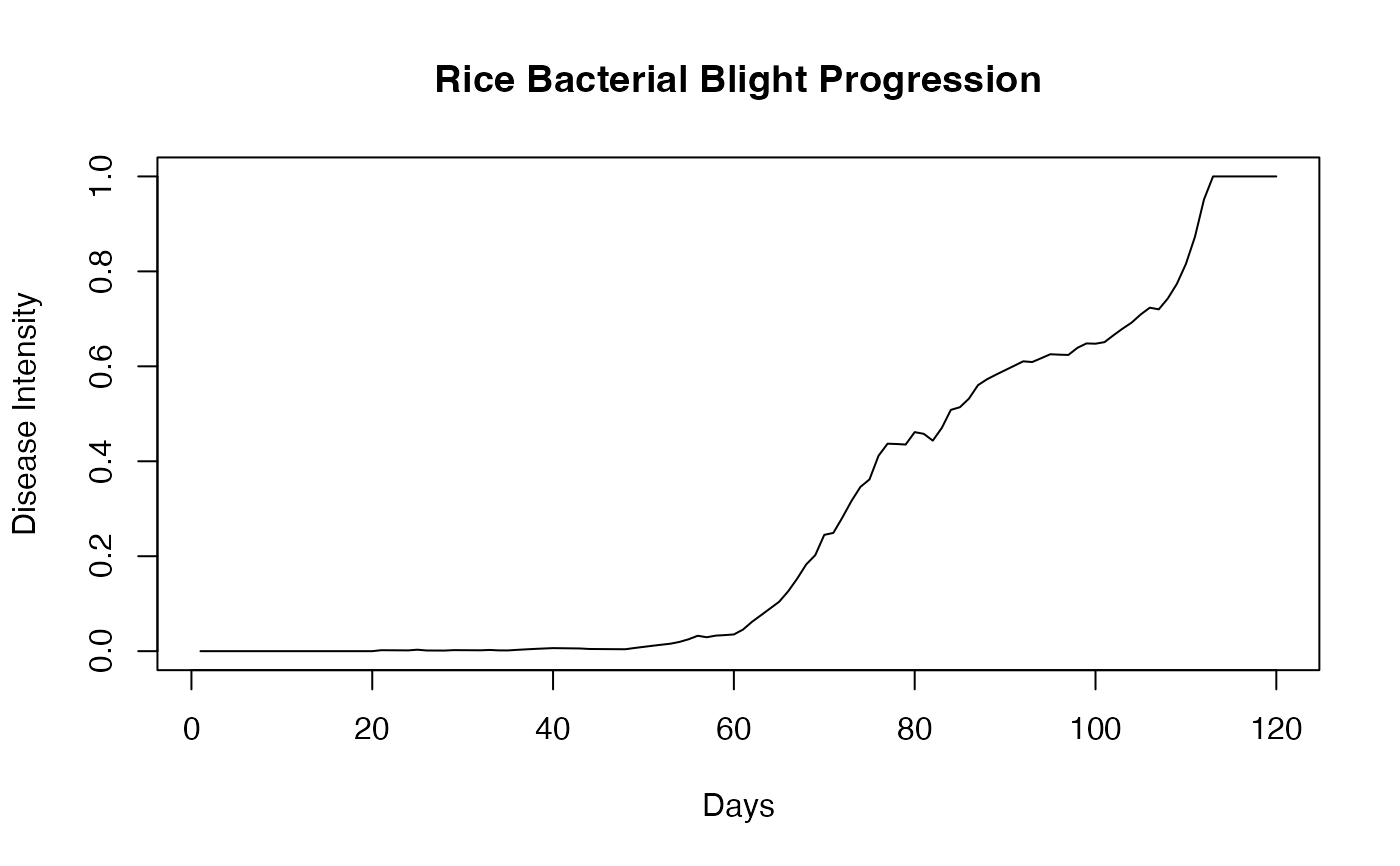
bacterial_blight() models rice bacterial blight (Xanthomonas oryzae
pv. oryzae). The disease requires high humidity and warm temperatures
(optimum 25–30°.RC)
and is most severe in the Philippines and Asia-Pacific
region.
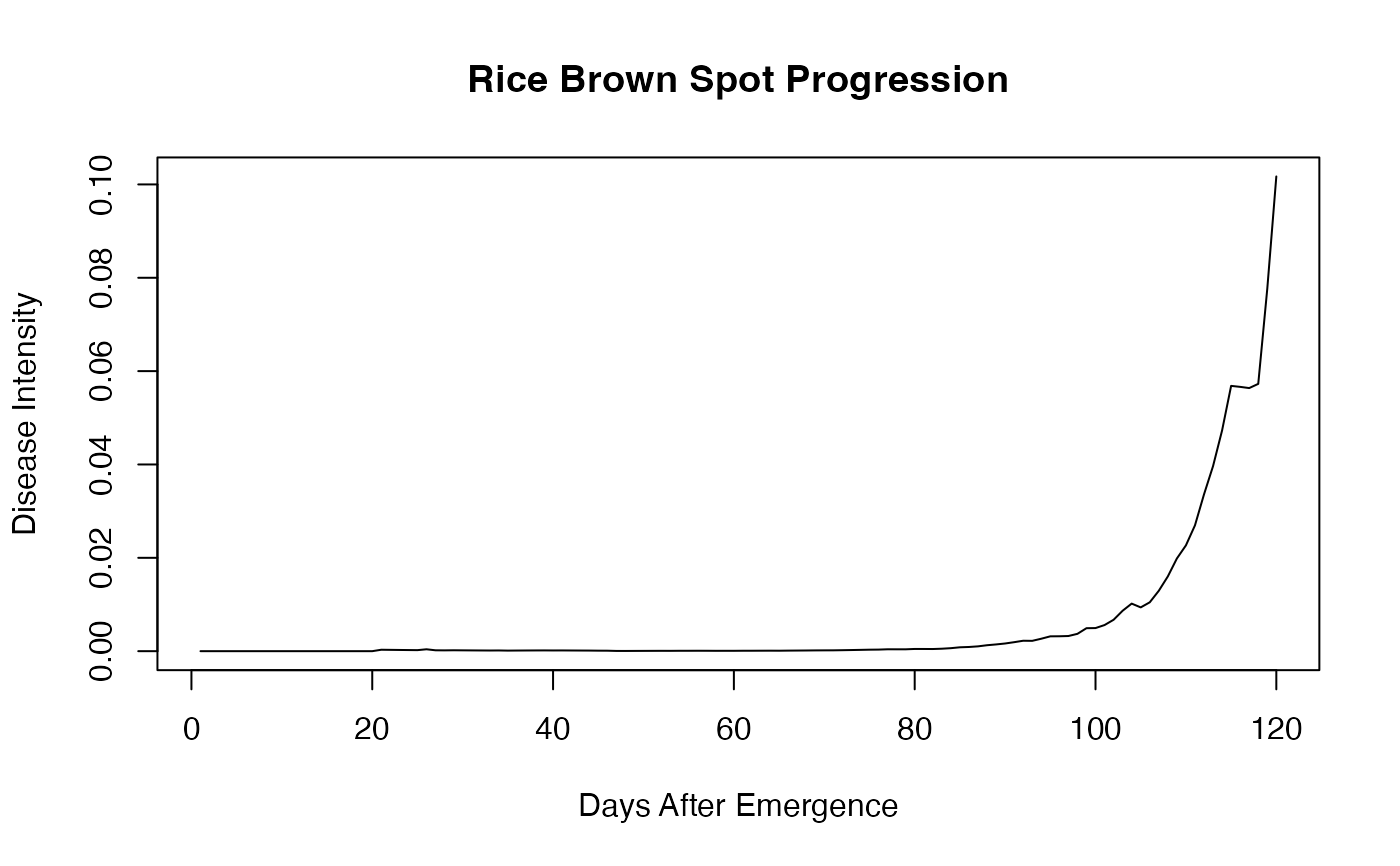
brown_spot() models rice brown spot (Bipolaris oryzae). A seed-borne
fungal disease prevalent in tropical and subtropical regions, particularly
damaging to older rice varieties.
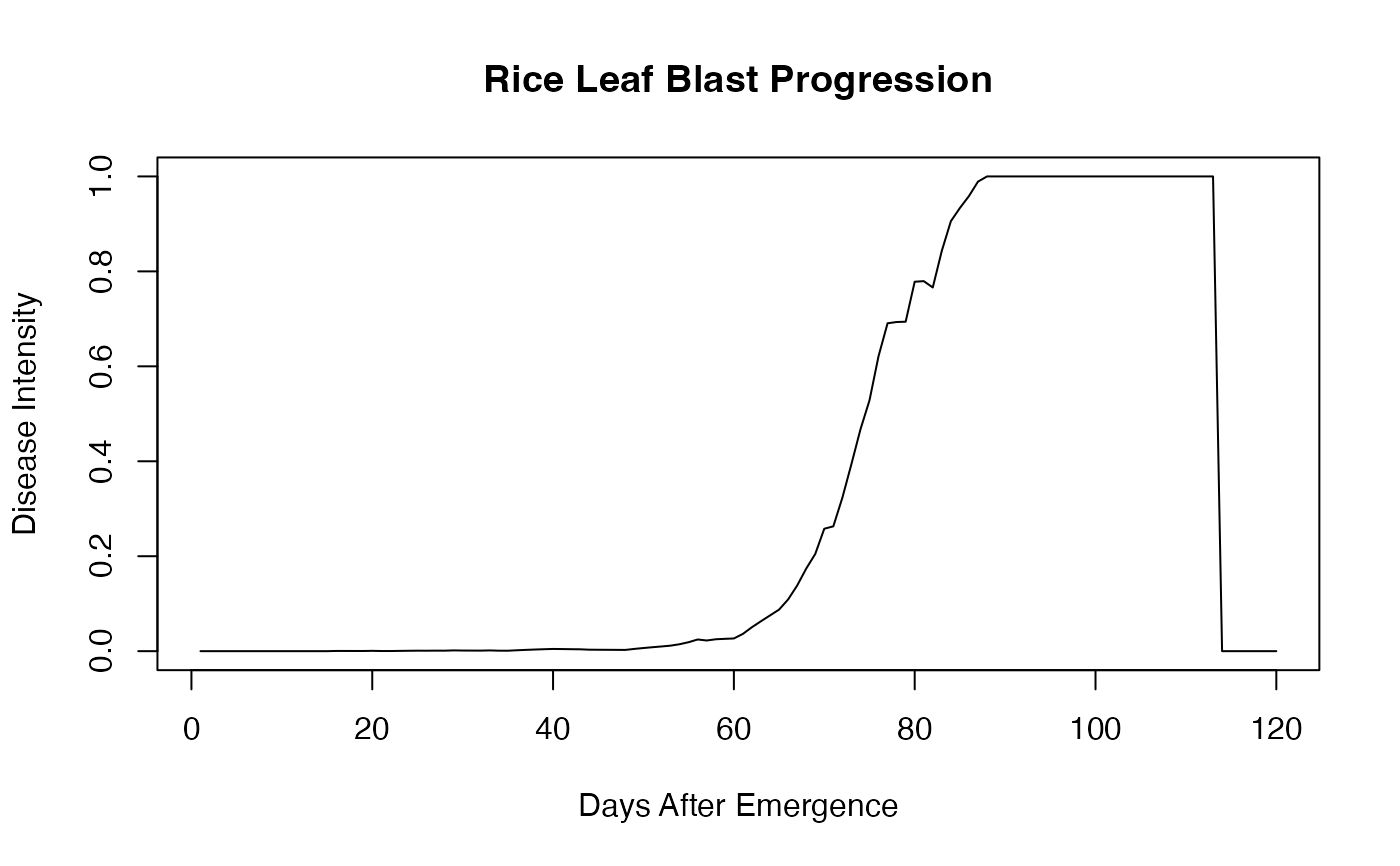
leaf_blast() models rice leaf blast (Magnaporthe oryzae). The most
economically important rice disease worldwide, favoured by cool
(25°.RC), wet conditions. Rapid disease
progression can cause total crop loss.
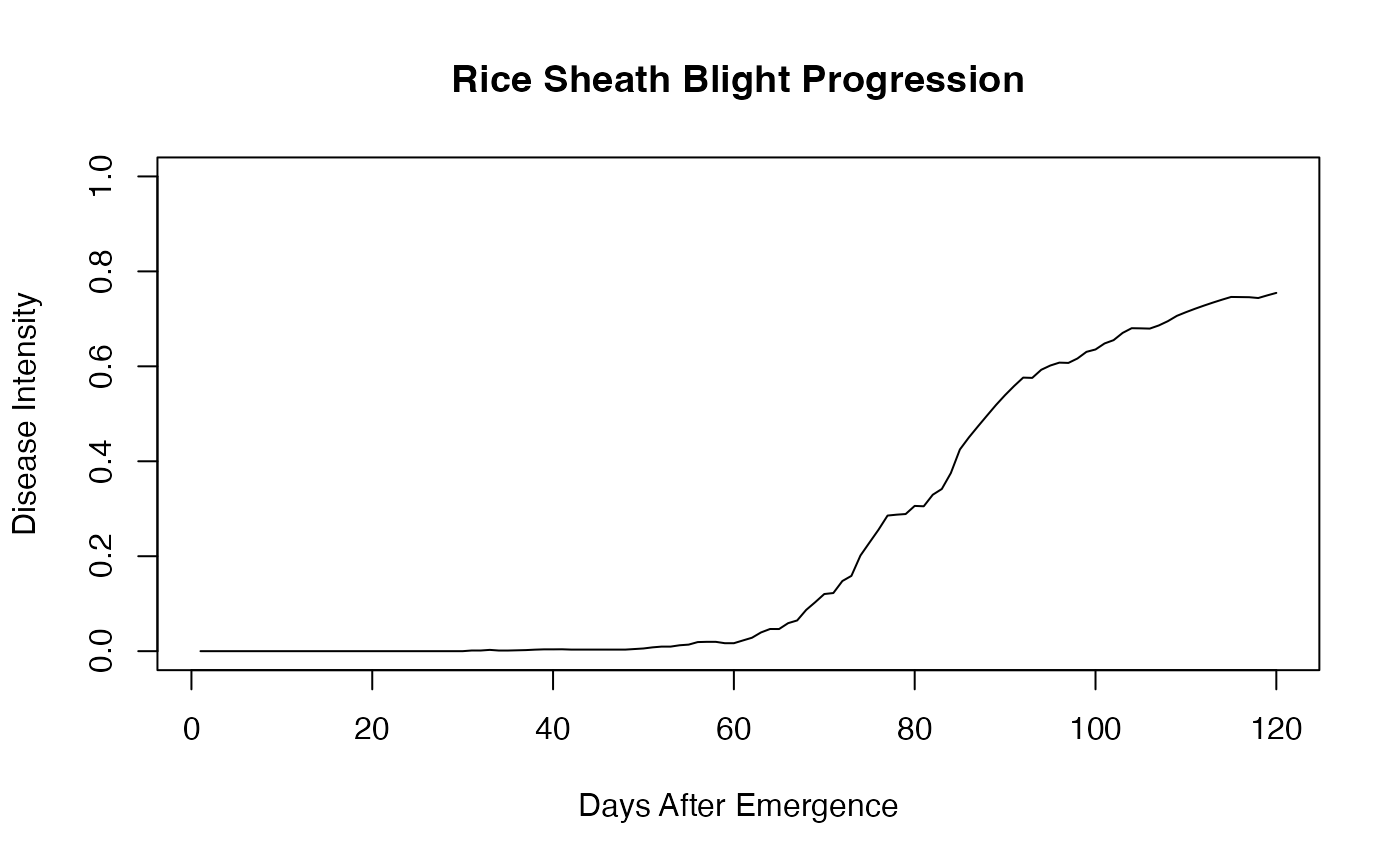
sheath_blight() models rice sheath blight (Rhizoctonia solani).
A soil-borne disease that infects the leaf sheath; can cause catastrophic
damage in high-N fertilized crops.
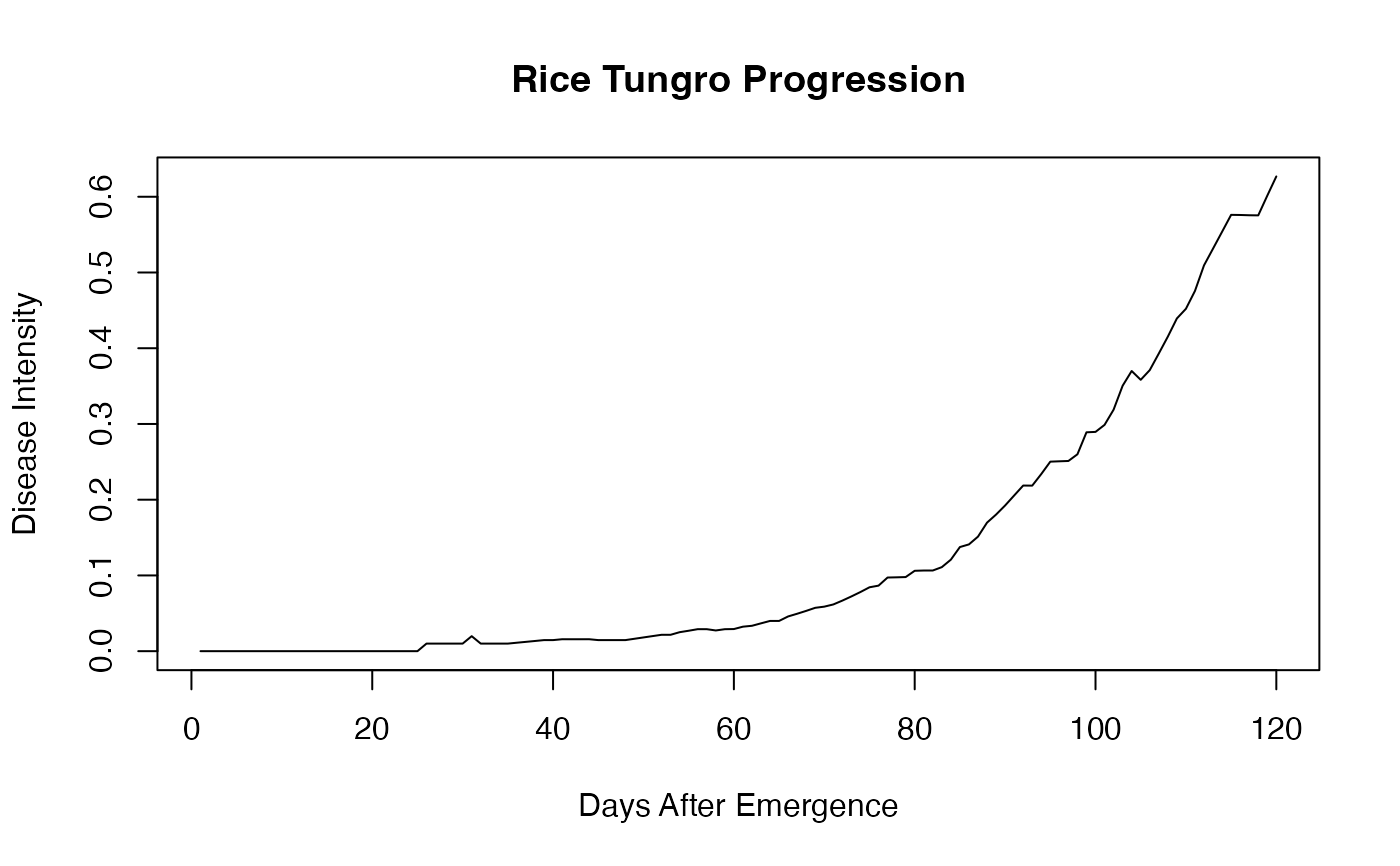
tungro() models rice tungro, a viral disease complex (Tungro bacilliform
and Tungro spherical viruses) transmitted by the insect vector
Nephotettix spp. Vector populations increase with temperature and
humidity; disease pressure peaks mid-season.
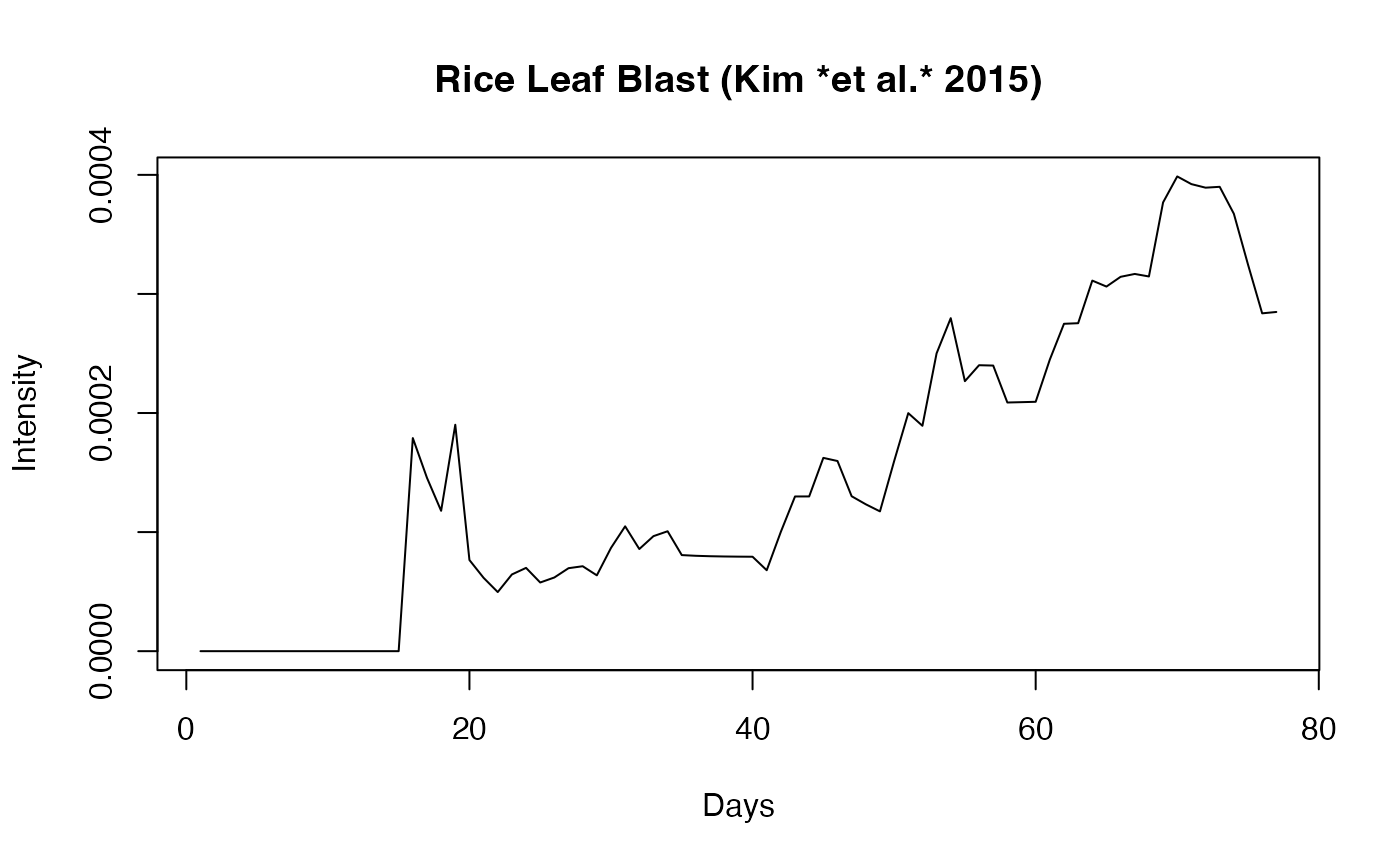
modified_kim_leaf_blast() models rice leaf blast using parameters from
Kim et al. (2015), calibrated for South Korean rice cultivars and growing
conditions.
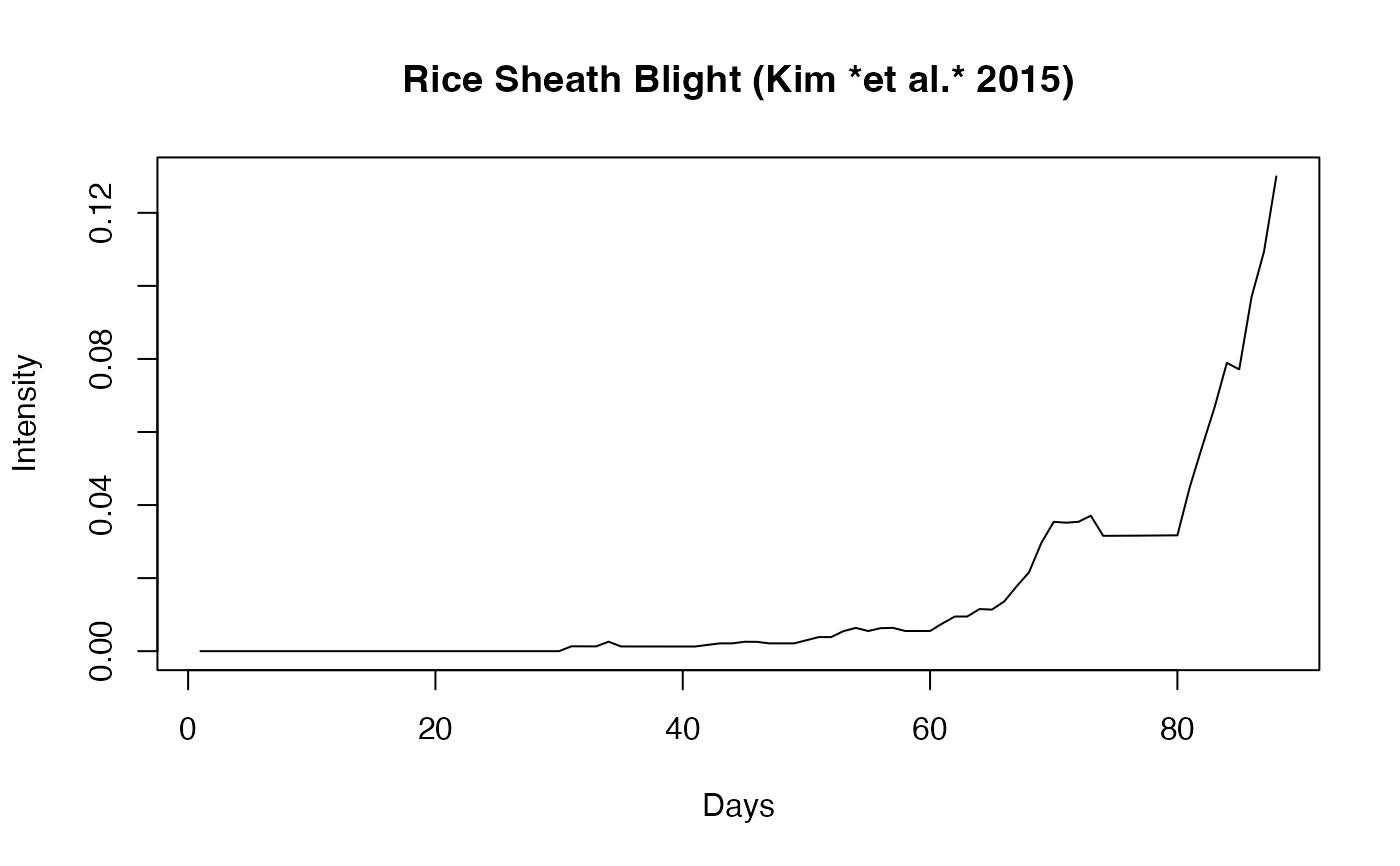
modified_kim_sheath_blight() models rice sheath blight using parameters
from Kim et al. (2015), calibrated for South Korean rice cultivars. Uses
slightly higher humidity threshold (95%) reflecting Korean monsoon climate.
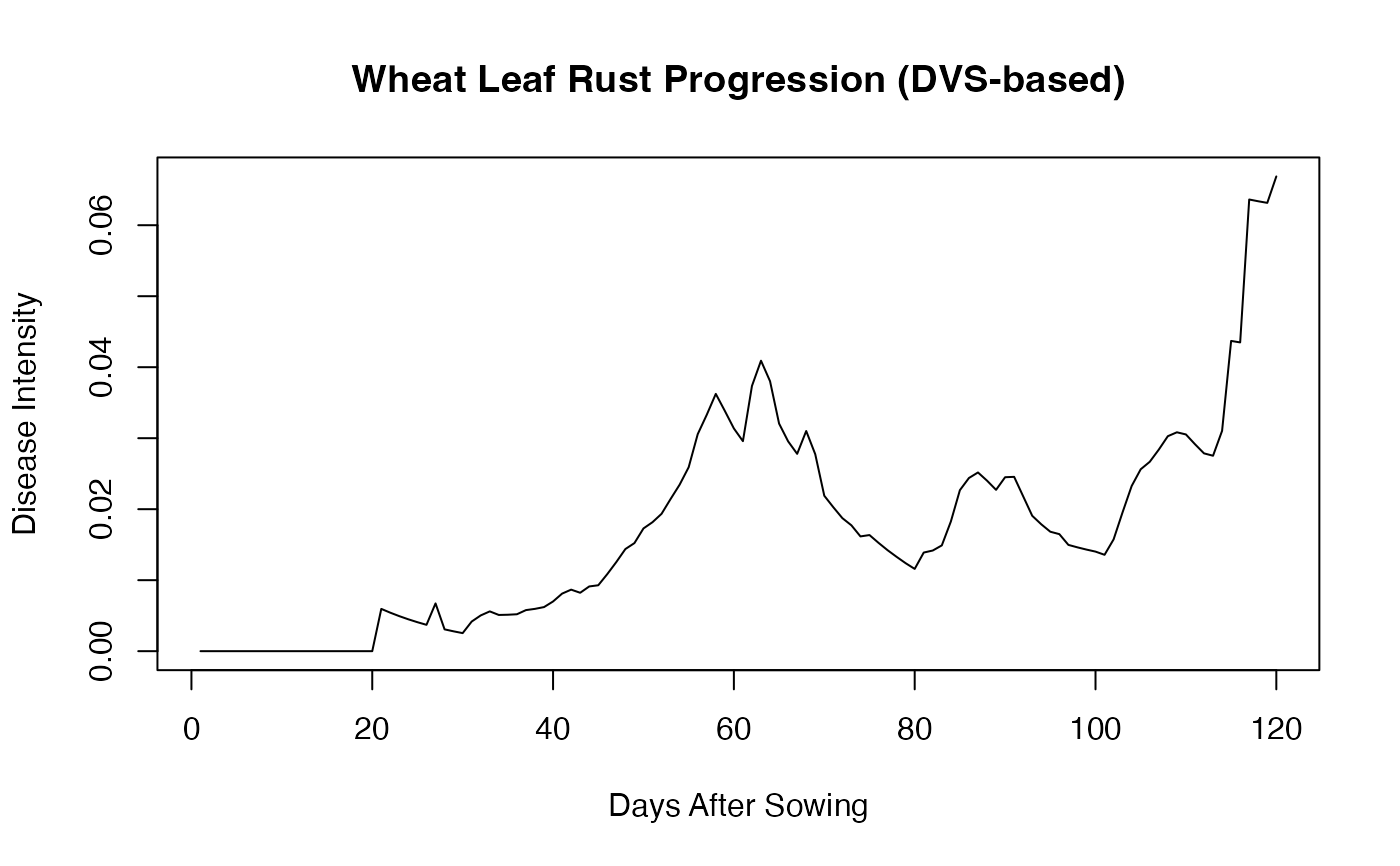
leaf_rust() models wheat leaf rust (Puccinia triticina). A major wheat
pathogen globally, favoured by moderate temperatures
(15–25°.RC) and high humidity. #' DVS-based
modelling accounts for developmental susceptibility.
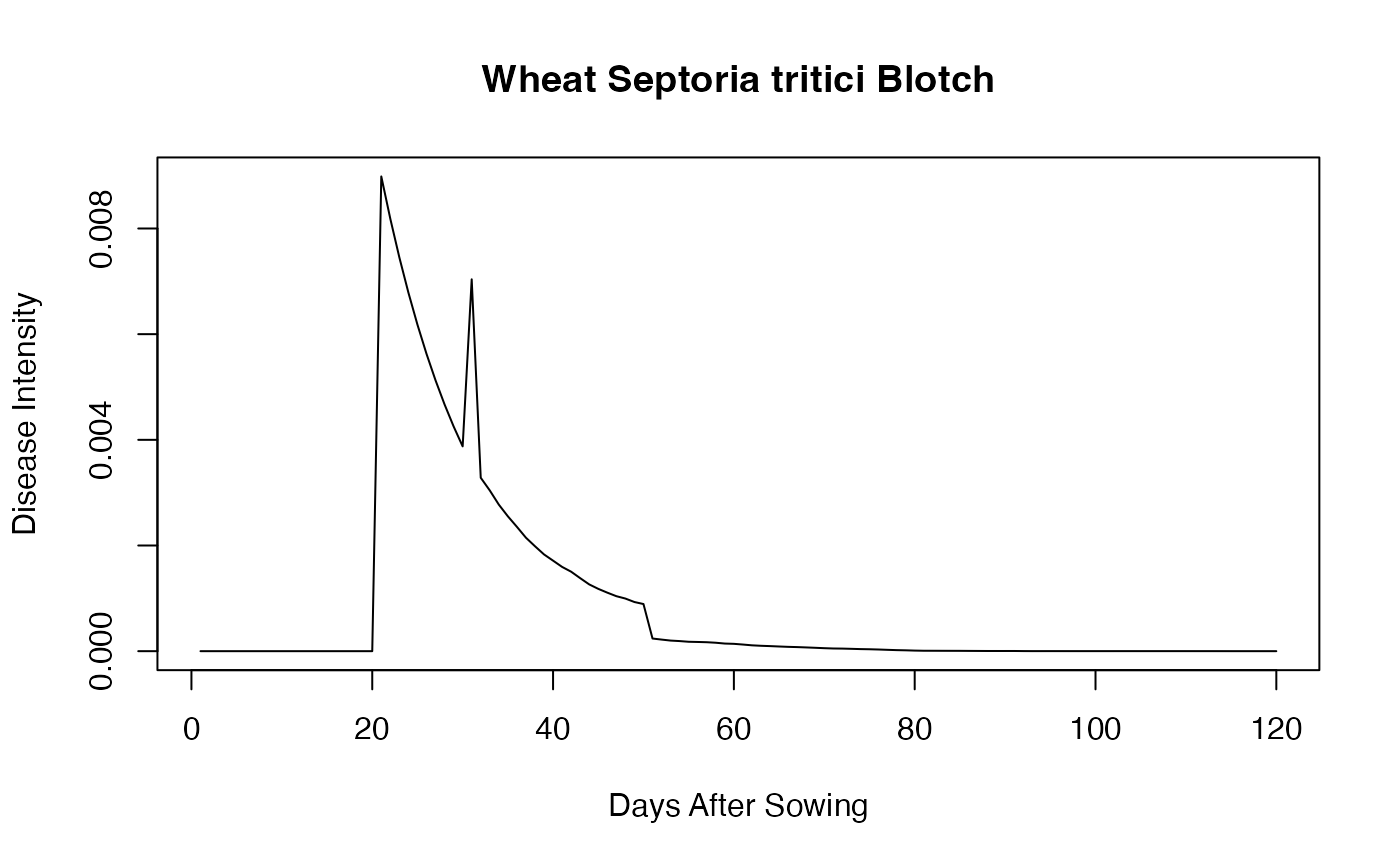
s_tritici_blotch() models wheat Septoria tritici blotch (Zymoseptoria
tritici), a major wheat pathogen in temperate regions. Features lesion
expansion (direct H→I pathway) allowing rapid canopy senescence.
DVS-based modelling accounts for developmental susceptibility.
bb() is an alias for bacterial_blight().
bs() is an alias for brown_spot().
lb() is an alias for leaf_blast().
sb() is an alias for sheath_blight().
tg() is an alias for tungro().
mk_lb() is an alias for modified_kim_leaf_blast().
mk_sb() is an alias for modified_kim_sheath_blight().
lr() is an alias for leaf_rust().
brown_rust() is an alias for leaf_rust().
stb() is an alias for s_tritici_blotch().
Usage
bacterial_blight(
  wth,
  emergence,
  RcA = NULL,
  RcT = NULL,
  RRS = NULL,
  RRG = NULL,
  rhlim = NULL,
  rainlim = NULL,
  ...
)

brown_spot(
  wth,
  emergence,
  RcA = NULL,
  RcT = NULL,
  RRS = NULL,
  RRG = NULL,
  rhlim = NULL,
  rainlim = NULL,
  ...
)

leaf_blast(
  wth,
  emergence,
  RcA = NULL,
  RcT = NULL,
  RRS = NULL,
  RRG = NULL,
  rhlim = NULL,
  rainlim = NULL,
  ...
)

sheath_blight(
  wth,
  emergence,
  RcA = NULL,
  RcT = NULL,
  RRS = NULL,
  RRG = NULL,
  rhlim = NULL,
  rainlim = NULL,
  ...
)

tungro(
  wth,
  emergence,
  RcA = NULL,
  RcT = NULL,
  RRS = NULL,
  RRG = NULL,
  rhlim = NULL,
  rainlim = NULL,
  ...
)

modified_kim_leaf_blast(
  wth,
  emergence,
  RcA = NULL,
  RcT = NULL,
  RRS = NULL,
  RRG = NULL,
  rhlim = NULL,
  rainlim = NULL,
  ...
)

modified_kim_sheath_blight(
  wth,
  emergence,
  RcA = NULL,
  RcT = NULL,
  RRS = NULL,
  RRG = NULL,
  rhlim = NULL,
  rainlim = NULL,
  ...
)

leaf_rust(
  wth,
  emergence,
  RcA = NULL,
  RcT = NULL,
  RRPSN = NULL,
  RRG = NULL,
  rhlim = NULL,
  rainlim = NULL,
  ...
)

s_tritici_blotch(
  wth,
  emergence,
  RcA = NULL,
  RcT = NULL,
  RRPSN = NULL,
  RRG = NULL,
  rhlim = NULL,
  rainlim = NULL,
  ...
)

bb(
  wth,
  emergence,
  RcA = NULL,
  RcT = NULL,
  RRS = NULL,
  RRG = NULL,
  rhlim = NULL,
  rainlim = NULL,
  ...
)

bs(
  wth,
  emergence,
  RcA = NULL,
  RcT = NULL,
  RRS = NULL,
  RRG = NULL,
  rhlim = NULL,
  rainlim = NULL,
  ...
)

lb(
  wth,
  emergence,
  RcA = NULL,
  RcT = NULL,
  RRS = NULL,
  RRG = NULL,
  rhlim = NULL,
  rainlim = NULL,
  ...
)

sb(
  wth,
  emergence,
  RcA = NULL,
  RcT = NULL,
  RRS = NULL,
  RRG = NULL,
  rhlim = NULL,
  rainlim = NULL,
  ...
)

tg(
  wth,
  emergence,
  RcA = NULL,
  RcT = NULL,
  RRS = NULL,
  RRG = NULL,
  rhlim = NULL,
  rainlim = NULL,
  ...
)

mk_lb(
  wth,
  emergence,
  RcA = NULL,
  RcT = NULL,
  RRS = NULL,
  RRG = NULL,
  rhlim = NULL,
  rainlim = NULL,
  ...
)

mk_sb(
  wth,
  emergence,
  RcA = NULL,
  RcT = NULL,
  RRS = NULL,
  RRG = NULL,
  rhlim = NULL,
  rainlim = NULL,
  ...
)

lr(
  wth,
  emergence,
  RcA = NULL,
  RcT = NULL,
  RRPSN = NULL,
  RRG = NULL,
  rhlim = NULL,
  rainlim = NULL,
  ...
)

brown_rust(
  wth,
  emergence,
  RcA = NULL,
  RcT = NULL,
  RRPSN = NULL,
  RRG = NULL,
  rhlim = NULL,
  rainlim = NULL,
  ...
)

stb(
  wth,
  emergence,
  RcA = NULL,
  RcT = NULL,
  RRPSN = NULL,
  RRG = NULL,
  rhlim = NULL,
  rainlim = NULL,
  ...
)
Arguments
- wth
A
data.frameof classepicrop.wthfromget_wth()orformat_wth()containing daily weather data with columns:Required Columns:
Column Description YYYYMMDD Date (ISO 8601: YYYYMMDD) DOY Day of year (1–366) TEMP Mean daily temperature (°.RC) RHUM Mean daily relative humidity (%) RAIN Daily rainfall (mm) Optional Columns (for advanced features):
Column Purpose TMIN Minimum daily temperature (°.RC); required if simple_wetness = FALSETMAX Maximum daily temperature (°.RC); required if simple_wetness = FALSELAT Latitude; required if simple_wetness = FALSELON Longitude; included in output if present - emergence
Plant emergence (transplanting for rice) date in
YYYY-MM-DDformat (character).- RcA
Optional custom age modifier table (2-column numeric matrix). Overrides the published default for this disease.
- RcT
Optional custom temperature modifier table (2-column numeric matrix). Overrides the published default for this disease.
- RRS
Optional custom relative senescence rate (scalar numeric, vector, function, or matrix). Overrides the published default. Applies to rice disease models only.
- RRG
Optional custom relative growth rate (scalar numeric, vector, or function). Overrides the published default.
- rhlim
Optional override for relative humidity threshold (%) for leaf wetness. Defaults to disease-specific value (typically 90).
- rainlim
Optional override for rainfall threshold (mm) for leaf wetness. Defaults to disease-specific value (typically 5).
- ...
Additional parameters passed to
seir(), allowing full customization of any parameter (onset, duration, H0, I0, p, i, Sx, a, simple_wetness, etc.).- RRPSN
Optional custom relative photoperiod-adjusted senescence rate (scalar numeric, vector, function, or matrix). Overrides the published default. Applies to wheat disease models only.
Value
A data.table::data.table() of class epicrop.sim with disease
progression over time. See seir() for output details.
Details
All functions support parameter override via ... arguments, enabling
sensitivity analysis and custom cultivar/environment modelling.
Available Models
Rice Diseases (Savary et al. 2012):
bacterial_blight()– Bacterial blight (Xanthomonas oryzae pv. oryzae)brown_spot()– Brown spot (Bipolaris oryzae)leaf_blast()– Leaf blast (Magnaporthe oryzae)sheath_blight()– Sheath blight (Rhizoctonia solani)tungro()– Tungro (viral, vector-borne)
Rice Diseases (Kim et al. 2015 modifications):
modified_kim_leaf_blast()– Cultivar-adjusted leaf blastmodified_kim_sheath_blight()– Cultivar-adjusted sheath blight
Wheat Diseases (Savary et al. 2015):
leaf_rust()– Leaf rust (Puccinia triticina)s_tritici_blotch()– Septoria tritici blotch (Zymoseptoria tritici)
Parameter Sources
Rice models use baseline parameters from:
Savary et al. (2012) – Original parameterisation from literature
Kim et al. (2015) – Versions calibrated for Korean rice cultivars
Wheat models use:
Savary et al. (2015) – European calibration
TMIN/TMAX Details
When simple_wetness = FALSE, the function calculates hourly leaf wetness
for 24 hours using TMIN, TMAX, LAT, and DOY in the wth object.
The rhlim and rainlim thresholds determine wet hours. A leaf-wetness
modifier (RcW) converts wet hours to a 0–1 Rc scale.
When simple_wetness = TRUE, this calculation is skipped; leaf wetness is
binary (0 or 1) based solely on daily RHUM and RAIN.
LAT/LON Details
If the wth object contains LAT and LON columns, they are appended to
each row of the output for mapping or spatial analysis. Both must be present
to be included. By default, get_wth() and format_wth() provide these.
References
Savary, S., Nelson, A., Willocquet, L., Pangga, I., and Aunario, J. 2012. Modeling and mapping potential epidemics of rice diseases globally. Crop Protection, 34: 6–17. doi:10.1016/j.cropro.2011.11.009
Kim, K. H., Cho, J., Lee, Y. H., and Lee, W. S. 2015. Predicting potential epidemics of rice leaf blast and sheath blight in South Korea. Agricultural and Forest Meteorology, 203: 191–207. doi:10.1016/j.agrformet.2015.01.011
Savary, S., Stetkiewicz, S., Brun, F., and Willocquet, L. 2015. Modelling and mapping potential epidemics of wheat diseases. European Journal of Plant Pathology, 142: 771–790. doi:10.1007/s10658-015-0650-7
Author
Adam H. Sparks, adamhsparks@gmail.com
Examples
# Fetch weather data for a location in the Philippines
wth <- get_wth(
lonlat = c(121.255669, 14.16742),
dates = "2000-06-30",
duration = 120L
)
# Run bacterial blight model with default parameters (Savary *et al.* 2012)
bb_sim <- bacterial_blight(
wth = wth,
emergence = "2000-06-30"
)
# Inspect results
head(bb_sim)
#> simday dates sites latent infectious removed senesced rateinf rlex
#> <int> <IDat> <num> <num> <num> <num> <num> <num> <num>
#> 1: 1 2000-06-30 100.0000 0 0 0 1.000000 0 0
#> 2: 2 2000-07-01 108.6875 0 0 0 2.086875 0 0
#> 3: 3 2000-07-02 118.1002 0 0 0 3.267877 0 0
#> 4: 4 2000-07-03 128.2934 0 0 0 4.550811 0 0
#> 5: 5 2000-07-04 139.3254 0 0 0 5.944065 0 0
#> 6: 6 2000-07-05 151.2581 0 0 0 7.456646 0 0
#> rtransfer rremoved rgrowth rsenesced diseased intensity lat lon
#> <num> <num> <num> <num> <num> <num> <num> <num>
#> 1: 0 0 9.68750 1.000000 0 0 14.16742 121.2557
#> 2: 0 0 10.49959 1.086875 0 0 14.16742 121.2557
#> 3: 0 0 11.37416 1.181002 0 0 14.16742 121.2557
#> 4: 0 0 12.31499 1.282934 0 0 14.16742 121.2557
#> 5: 0 0 13.32593 1.393254 0 0 14.16742 121.2557
#> 6: 0 0 14.41084 1.512581 0 0 14.16742 121.2557
plot(bb_sim$simday, bb_sim$intensity, type = "l",
main = "Rice Bacterial Blight Progression",
xlab = "Days", ylab = "Disease Intensity")
 # Simulate brown spot for a standard rice season
wth <- get_wth(
lonlat = c(121.255669, 14.16742),
dates = "2000-06-30",
duration = 120L
)
bs_sim <- brown_spot(
wth = wth,
emergence = "2000-06-30"
)
# Brown spot develops slowly compared to leaf blast
plot(bs_sim$simday, bs_sim$intensity, type = "l",
main = "Rice Brown Spot Progression",
xlab = "Days After Emergence", ylab = "Disease Intensity")
# Simulate brown spot for a standard rice season
wth <- get_wth(
lonlat = c(121.255669, 14.16742),
dates = "2000-06-30",
duration = 120L
)
bs_sim <- brown_spot(
wth = wth,
emergence = "2000-06-30"
)
# Brown spot develops slowly compared to leaf blast
plot(bs_sim$simday, bs_sim$intensity, type = "l",
main = "Rice Brown Spot Progression",
xlab = "Days After Emergence", ylab = "Disease Intensity")
 # Simulate leaf blast under favourable conditions
wth <- get_wth(
lonlat = c(121.255669, 14.16742),
dates = "2000-06-30",
duration = 120L
)
lb_sim <- leaf_blast(
wth = wth,
emergence = "2000-06-30"
)
# Leaf blast shows rapid increase in intensity after onset
plot(lb_sim$simday, lb_sim$intensity, type = "l", ylim = c(0, 1),
main = "Rice Leaf Blast Progression",
xlab = "Days After Emergence", ylab = "Disease Intensity")
# Simulate leaf blast under favourable conditions
wth <- get_wth(
lonlat = c(121.255669, 14.16742),
dates = "2000-06-30",
duration = 120L
)
lb_sim <- leaf_blast(
wth = wth,
emergence = "2000-06-30"
)
# Leaf blast shows rapid increase in intensity after onset
plot(lb_sim$simday, lb_sim$intensity, type = "l", ylim = c(0, 1),
main = "Rice Leaf Blast Progression",
xlab = "Days After Emergence", ylab = "Disease Intensity")
 wth <- get_wth(
lonlat = c(121.255669, 14.16742),
dates = "2000-06-30",
duration = 120L
)
sb_sim <- sheath_blight(
wth = wth,
emergence = "2000-06-30"
)
# Sheath blight has long infectious period and delayed onset
plot(sb_sim$simday, sb_sim$intensity, type = "l", ylim = c(0, 1),
main = "Rice Sheath Blight Progression",
xlab = "Days After Emergence", ylab = "Disease Intensity")
wth <- get_wth(
lonlat = c(121.255669, 14.16742),
dates = "2000-06-30",
duration = 120L
)
sb_sim <- sheath_blight(
wth = wth,
emergence = "2000-06-30"
)
# Sheath blight has long infectious period and delayed onset
plot(sb_sim$simday, sb_sim$intensity, type = "l", ylim = c(0, 1),
main = "Rice Sheath Blight Progression",
xlab = "Days After Emergence", ylab = "Disease Intensity")
 # Simulate tungro (vector-borne viral disease)
wth <- get_wth(
lonlat = c(121.255669, 14.16742),
dates = "2000-06-30",
duration = 120L
)
tg_sim <- tungro(
wth = wth,
emergence = "2000-06-30"
)
# Tungro shows plateau phase (low Sx due to limited vector population)
plot(tg_sim$simday, tg_sim$intensity, type = "l",
main = "Rice Tungro Progression",
xlab = "Days After Emergence", ylab = "Disease Intensity")
# Simulate tungro (vector-borne viral disease)
wth <- get_wth(
lonlat = c(121.255669, 14.16742),
dates = "2000-06-30",
duration = 120L
)
tg_sim <- tungro(
wth = wth,
emergence = "2000-06-30"
)
# Tungro shows plateau phase (low Sx due to limited vector population)
plot(tg_sim$simday, tg_sim$intensity, type = "l",
main = "Rice Tungro Progression",
xlab = "Days After Emergence", ylab = "Disease Intensity")
 # Simulate using Kim *et al.* (2015) cultivar-adjusted parameters
wth <- get_wth(
lonlat = c(126.9780, 37.5665), # Seoul, South Korea
dates = "2000-06-01",
duration = 77L
)
kim_lb <- modified_kim_leaf_blast(
wth = wth,
emergence = "2000-06-01"
)
# Kim version has shorter duration and higher Sx (larger canopy model)
plot(kim_lb$simday, kim_lb$intensity, type = "l",
main = "Rice Leaf Blast (Kim *et al.* 2015)",
xlab = "Days", ylab = "Intensity")
# Simulate using Kim *et al.* (2015) cultivar-adjusted parameters
wth <- get_wth(
lonlat = c(126.9780, 37.5665), # Seoul, South Korea
dates = "2000-06-01",
duration = 77L
)
kim_lb <- modified_kim_leaf_blast(
wth = wth,
emergence = "2000-06-01"
)
# Kim version has shorter duration and higher Sx (larger canopy model)
plot(kim_lb$simday, kim_lb$intensity, type = "l",
main = "Rice Leaf Blast (Kim *et al.* 2015)",
xlab = "Days", ylab = "Intensity")
 # Simulate sheath blight with Kim *et al.* (2015) parameters
wth <- get_wth(
lonlat = c(126.9780, 37.5665),
dates = "2000-06-01",
duration = 88L
)
kim_sb <- modified_kim_sheath_blight(
wth = wth,
emergence = "2000-06-01"
)
plot(kim_sb$simday, kim_sb$intensity, type = "l",
main = "Rice Sheath Blight (Kim *et al.* 2015)",
xlab = "Days", ylab = "Intensity")
# Simulate sheath blight with Kim *et al.* (2015) parameters
wth <- get_wth(
lonlat = c(126.9780, 37.5665),
dates = "2000-06-01",
duration = 88L
)
kim_sb <- modified_kim_sheath_blight(
wth = wth,
emergence = "2000-06-01"
)
plot(kim_sb$simday, kim_sb$intensity, type = "l",
main = "Rice Sheath Blight (Kim *et al.* 2015)",
xlab = "Days", ylab = "Intensity")
 # Simulate wheat leaf rust with DVS (development stage) modelling
wth <- get_wth(
lonlat = c(8.5, 50.1), # Example: France
dates = "2000-10-15", # Winter wheat sowing
duration = 240L # Full growing season
)
lr_sim <- leaf_rust(
wth = wth,
emergence = "2000-10-15"
)
# Leaf rust shows gradual progression across growing season
plot(lr_sim$simday, lr_sim$intensity, type = "l",
main = "Wheat Leaf Rust Progression (DVS-based)",
xlab = "Days After Sowing", ylab = "Disease Intensity")
# Simulate wheat leaf rust with DVS (development stage) modelling
wth <- get_wth(
lonlat = c(8.5, 50.1), # Example: France
dates = "2000-10-15", # Winter wheat sowing
duration = 240L # Full growing season
)
lr_sim <- leaf_rust(
wth = wth,
emergence = "2000-10-15"
)
# Leaf rust shows gradual progression across growing season
plot(lr_sim$simday, lr_sim$intensity, type = "l",
main = "Wheat Leaf Rust Progression (DVS-based)",
xlab = "Days After Sowing", ylab = "Disease Intensity")
 # Example: Septoria tritici blotch - compare lesion expansion effect
# Fetch weather for a wheat-growing region (France, Oct-May season)
wth <- get_wth(
lonlat = c(8.5, 50.1),
dates = "2000-10-15",
duration = 240L
)
stb <- s_tritici_blotch(
wth = wth,
emergence = "2000-10-15"
)
# Create single plot with both lines for comparison
plot(stb$simday, stb$intensity,
type = "l", col = "black", lty = 1,
main = "Wheat Septoria tritici Blotch",
xlab = "Days After Sowing",
ylab = "Disease Intensity")
# Example: Septoria tritici blotch - compare lesion expansion effect
# Fetch weather for a wheat-growing region (France, Oct-May season)
wth <- get_wth(
lonlat = c(8.5, 50.1),
dates = "2000-10-15",
duration = 240L
)
stb <- s_tritici_blotch(
wth = wth,
emergence = "2000-10-15"
)
# Create single plot with both lines for comparison
plot(stb$simday, stb$intensity,
type = "l", col = "black", lty = 1,
main = "Wheat Septoria tritici Blotch",
xlab = "Days After Sowing",
ylab = "Disease Intensity")